Community Facing – Sustainable – Non-Extractive – Collaborative – Study Together – Radical Anti-Racism/Anti-Patriarchal
liberation (n.)(v.) studios, gallery; community-based collaborative practice
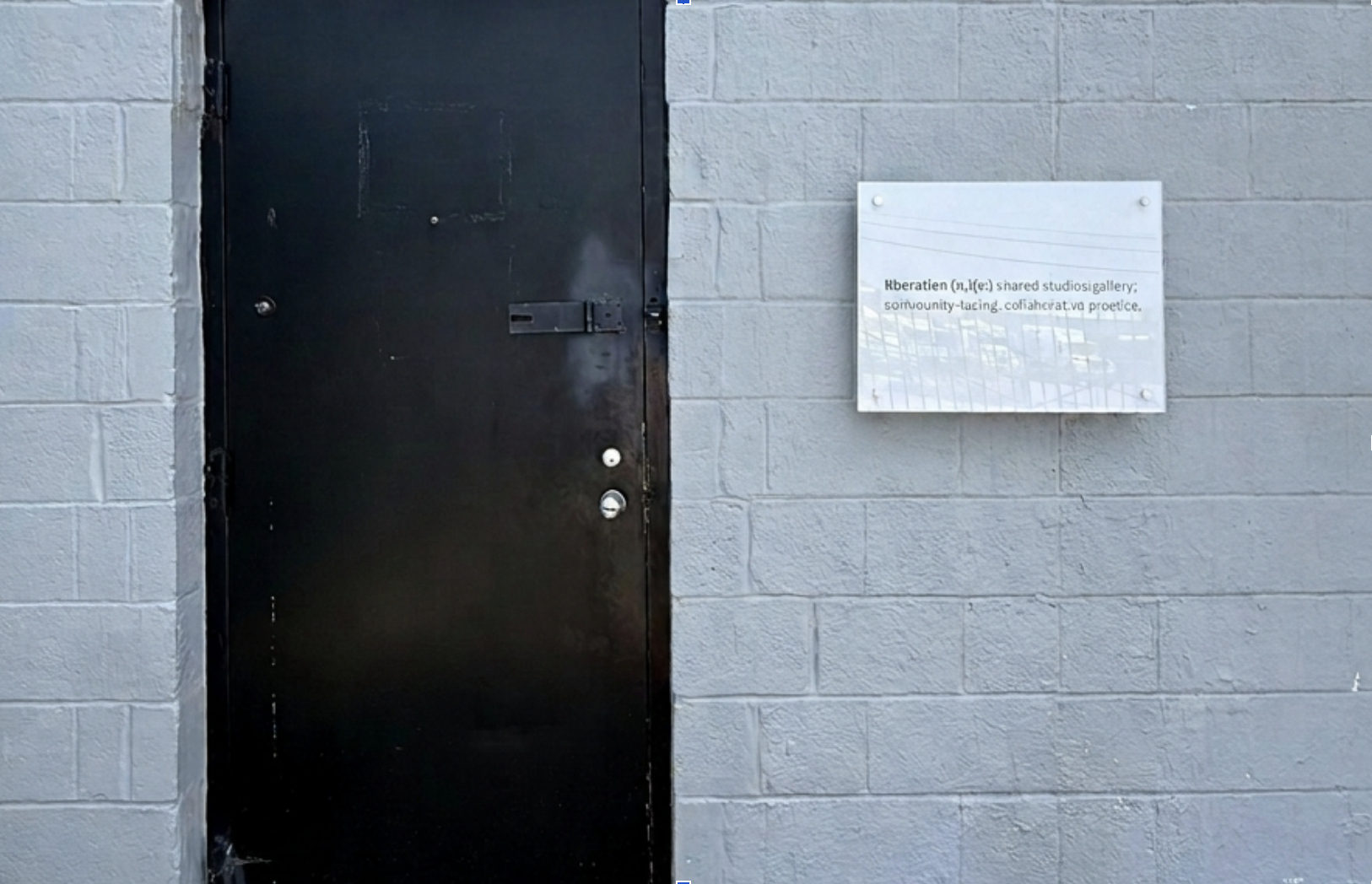
4113 Utah Avenue Brentwood, MD
A shared studio and residency space for equity-driven, community-engaged artists, artmaking and cultural work
Jason Bulluck, Director
liberationstudios.gallery@gmail.com
What We Offer
3–12 month studio associates (visual, culinary, hybrid) with access to:
Semi-private studio bays (micro, small, medium and double-small/large)
Access and training to shared tools (wood, metal, 2D/3D, fabrication-friendly)
Programming: studios visits, talks, collaborative community interventions, and resident artist-led critiques
Curatorial micro-residencies of 1-6 weeks each.
Digital residencies available for non-DMV artists.
Community-responsive programming shaped by residents
Freight Container Gallery (Launching Summer 2027)
A converted shipping container serving as the public gallery
Exhibitions, screenings, performances, and pop-ups
Resident-led shows alongside invited and community projects
Freight Container Culinary Residency (Launch TBD)
Short micro-residencies for marginalized chefs and food-based artists
Container-based kitchen for tastings, dinners, and public conversations
Focus on food justice, storytelling, and neighborhood engagement
Public Programs
Artist talks, workshops, exhibitions, events, and conversations
Hybrid programming for in-person and remote audiences
Application Process
Submit Application at any time (rolling admissions and decision within 7days of interview)
Tour of facility/360 interview: schedule a time to visit liberation and conduct a 360 interview
Letter of Acceptance and Studio License Signing
Security Deposit and First Month Licensing Fee → move-in
Who This Is For
Liberation is best suited for artists and cultural workers who:
Value process, critique, and mutual responsibility
Are interested in equity-centered, socially engaged practice
Want access to space and dialogue
Are comfortable working in a shared, evolving environment
This space is inspired by artist-organizer models (Carol Bebelle, Margaret Boozer, Rick Lowe, Theaster Gates and Amanda Williams) rather than solely market-driven studio rentals.
Structure & Access
Studios and residencies are application-based; 24hr access & required monthly salons
Participation includes light community expectations (open studios, dialogue, community event engagement, and care for shared space)
liberation’s licensing fees are transparent and scaled (approx. $150–$750/month depending on format):
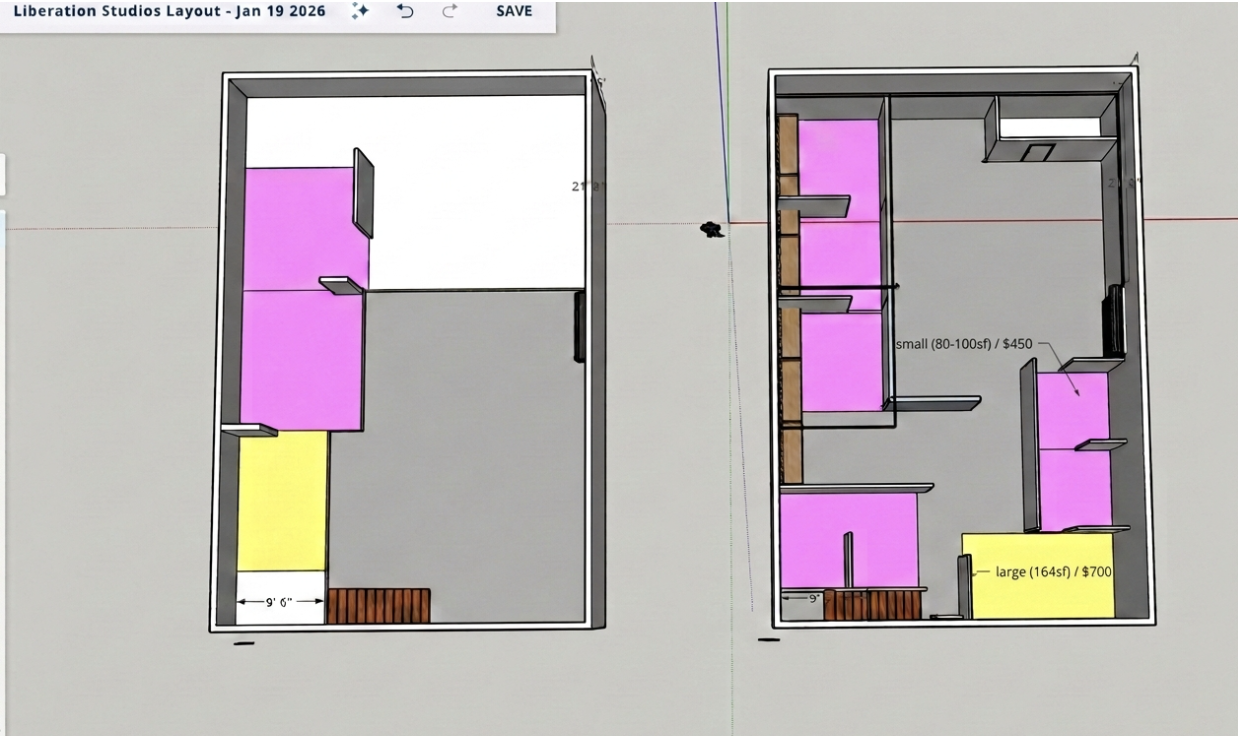
micro residency-license (coded magenta): includes access to a desk, programming, tools as available in a shared small studio space $200/mo licensing fee
small residency-license (coded magenta): includes access to 80-110sf semi-private studio space, programming, tools as available in a shared small studio space $450/mo licensing fee
medium residency-license (coded yellow): includes access to 80-110sf semi-private studio space, programming, tools as available in a shared small studio space $600/mo licensing fee
large/doule-small residency-license (coded magenta & side-by-side): includes access to 160-180sf semi-private studio space, programming, tools as available in a shared small studio space $750/mo licensing fee
liberation(discourse): On Liberation (as Method, Form, and Practice)
Liberation is not named here as an outcome already achieved, nor as a metaphor untethered from material conditions. It is understood instead as a discursive and (political) sculptural maneuver—a set of practices that operate within constraint, rupture, and unfinished struggle.
The project is indebted to Black critical thought, and particularly to the work of Hortense Spillers, whose writing insists that Black cultural production must be read not only for what it represents, but for how it reorganizes grammar, relation, and the terms of legibility itself. Liberation, in this sense, is not additive or corrective; it is recompositional.
Following the insights of Afropessimism, Liberation does not presume a stable social ground upon which repair is easily enacted. Instead, it acknowledges the ongoing condition of structural antagonism and the limits of inclusion as a solution. From this position, the work of the space is not optimism, but study.
Study in Community
liberation understands study as an active, collective process: learning together, thinking aloud, arguing carefully, and exteriorizing thought through conversation, making, and critique. This study is:
In-group and outward-facing
Multidisciplinary and political
Situated within real economic conditions
The studio, the gallery, the container, the table, the conversation, and rest are all treated as elements of a soci0-political art object—a multi-dimensional form shaped by use, repetition, and care.
This study is not extractive. It does not demand productivity without context, nor coherence without time. To be clear, there is no ‘customer service’ nor are there profits being extracted beyond what serves the artmaking and cultural participation of participating artists. It assumes that meaningful cultural work requires duration, trust, and the capacity to withstand rupture.
Ritual Repair & Trauma-Informed Structure
Liberation is designed with the expectation that disagreement, exhaustion, and fracture will occur. Rather than treating rupture as failure, the space foregrounds ritual repair: deliberate practices of return, recalibration, and care.
This orientation is trauma-informed without being therapeutic; it is structural rather than sentimental. Repair is understood as the ongoing labors of communication and care, not resolution.
Economic Grounding: Survival, Not Spectacle
Liberation is economically situated within the framework articulated by the Black Panther Party as survival pending revolution. The project does not promise escape from precarity, nor does it aestheticize scarcity. Instead, it builds modest, break-even infrastructure that allows cultural workers to remain in the work without being consumed by it.
Fees, shared resources, and mutual accountability are not barriers but tools for sustaining the conditions of study.
What Working at Liberation Studios Means in Practice
liberation is:
A studio where making is inseparable from thinking
A gallery where exhibition is a form of dialogue
A community that understands process as political
A space committed to learning with rather than producing for
liberation asks participants how they are willing to study, speak, listen, and repair in common.
APPLY to join LIBERATION STUDIOS
Link to Application on EntryThingy
Application Process
This application is intended to assess alignment, intent, and readiness. Applicants will be asked about:
Their practice and current work
Why this model resonates
How they imagine participating in a shared studio community
Practical considerations (timeline, space needs, tools, availability)